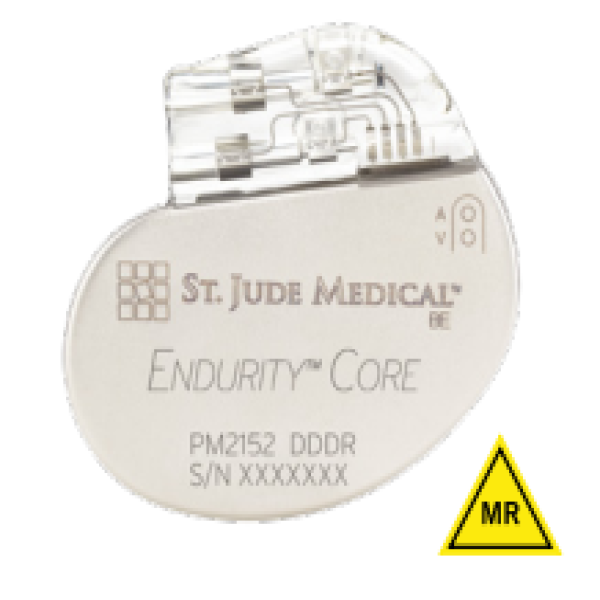
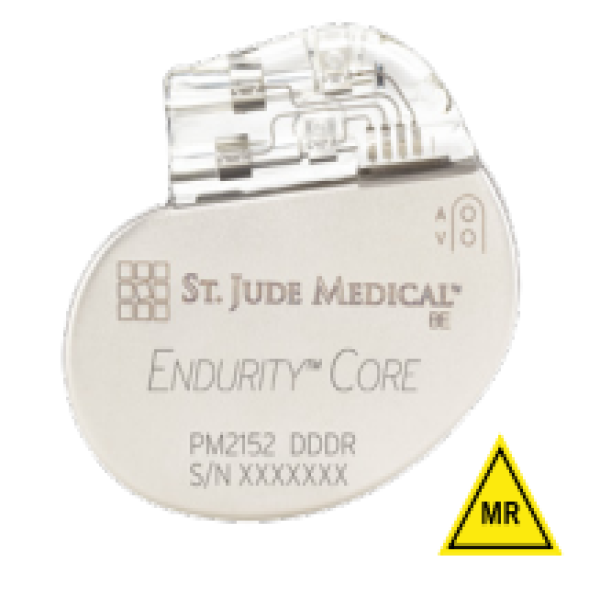
Endurity™ Core Dual-Chamber Pacemaker
- The Endurity™ Core pacemaker allows patients to undergo MRI scans*
- When combined with the Tendril™ 2088TC or IsoFlex™ Optim™ 1944/1948 leads, the MRI-ready device:
- – Allows MRI scans*
- – Permits a maximum whole body averaged specific absorption rate (SAR) of 2 Watts per kilogram (W/kg)
- Physician preferred size and physiologic shape minimize pocket size
Call Us Now
Product Highlights - Pacemaker
- The Endurity™ Core pacemaker allows patients to undergo MRI scans*
- When combined with the Tendril™ 2088TC or IsoFlex™ Optim™ 1944/1948 leads, the MRI-ready device:
- – Allows MRI scans*
- – Permits a maximum whole body averaged specific absorption rate (SAR) of 2 Watts per kilogram (W/kg)
- Physician preferred size and physiologic shape minimize pocket size
- Outstanding longevity provides 9,7 years of service life,1 which is supported by an 5-year warranty2
- AutoCapture™ pacing system offers the maximum in threshold adaptability and patient safety with ventricular Beat-by-Beat™ capture confirmation. The AutoCapture pacing system automatically delivers a 5,0 V backup safety pulse when noncapture is detected, and it may be programmed to either a bipolar or unipolar configuration
- State-of-the-art features
- – Ventricular Intrinsic Preference (VIP™) technology, and the AF Suppression™ algorithm, are designed to deliver optimal therapy for patients at implant and throughout their lives
- The only pacemaker with programmable AT/AF alerts specifically indicated for detecting atrial tachyarrhythmias, which have been found to be associated with an increased risk of stroke in elderly, hypertensive, pacemaker patients without prior history of AF3
- Real-time electrogram (EGM) waveform, as well as the associated event markers that precede and follow a specific triggering event, can be programmed to automatically record up to 2 minutes of stored EGMs when encountering one or more programmable trigger options
- An optional, easy-to-use hand-held device (SJM MRI Activator™ device) can be used to program the device to pre-approved MRI settings pre- and post-MRI scan, decreasing the number of workflow steps and increasing clinic efficiency
- 6-month ERI-EOL interval
Indications: Implantation is indicated in one or more of the following permanent conditions: syncope,
presyncope, fatigue, disorientation due to arrhythmia/bradycardia or any combination of those symptoms.
Rate-Modulated Pacing is indicated for patients with chronotropic incompetence, and for those who would
benefit from increased stimulation rates concurrent with physical activity. Dual-Chamber Pacing is indicated
for those patients exhibiting: sick sinus syndrome, chronic, symptomatic second- and third-degree AV
block, recurrent Adams-Stokes syndrome, symptomatic bilateral bundle branch block when tachyarrhythmia
and other causes have been ruled out. Atrial Pacing is indicated for patients with sinus node dysfunction
and normal AV and intraventricular conduction systems. Ventricular Pacing is indicated for patients
with significant bradycardia and normal sinus rhythm with only rare episodes of A-V block or sinus arrest,
chronic atrial fibrillation, severe physical disability. AF Suppression algorithm is indicated for suppression
of paroxysmal or persistent atrial fibrillation episodes in patients with one or more of the above pacing
indications.
Contraindications: Dual-chamber pulse generators are contraindicated in patients with an implanted
cardioverter-defibrillator. Rate-Adaptive Pacing may be inappropriate for patients who experience angina
or other symptoms of myocardial dysfunction at higher sensor-driven rates. An appropriate Maximum Sensor
Rate should be selected based on assessment of the highest stimulation rate tolerated by the patient.
AF Suppression stimulation is not recommended in patients who cannot tolerate high atrial-rate stimulation.
Dual-Chamber Pacing, though not contraindicated for patients with chronic atrial flutter, chronic atrial
fibrillation or silent atria, may provide no benefit beyond that of single-chamber pacing in such patients.
Single-Chamber Ventricular Demand Pacing is relatively contraindicated in patients who have demonstrated
pacemaker syndrome, have retrograde VA conduction or suffer a drop in arterial blood pressure with the
onset of ventricular pacing. Single-Chamber Atrial Pacing is relatively contraindicated in patients who have
demonstrated compromise of AV conduction.
Potential Adverse Events: The following are potential complications associated with the use of any pacing
system: arrhythmia, heart block, thrombosis, threshold elevation, valve damage, pneumothorax, myopotential
sensing, vessel damage, air embolism, body rejection phenomena, cardiac tamponade or perforation,
formation of fibrotic tissue/local tissue reaction, inability to interrogate or program a device because of
programmer malfunction, infection, interruption of desired device function due to electrical interference,
loss of desired pacing and/or sensing due to lead displacement, body reaction at electrode interface or
lead malfunction (fracture or damage to insulation), loss of normal device function due to battery failure or
component malfunction, device migration, pocket erosion or hematoma, pectoral muscle stimulation, phrenic
nerve or diaphragmatic stimulation. The following, in addition to the above, are potential complications
associated with the use of rate-modulated pacing systems: inappropriate, rapid pacing rates due to sensor
failure or to the detection of signals other than patient activity, loss of activity-response due to sensor failure,
palpitations with high-rate pacing.
Refer to the User’s Manual for detailed indications, contraindications, warnings, precautions and potential
adverse events.