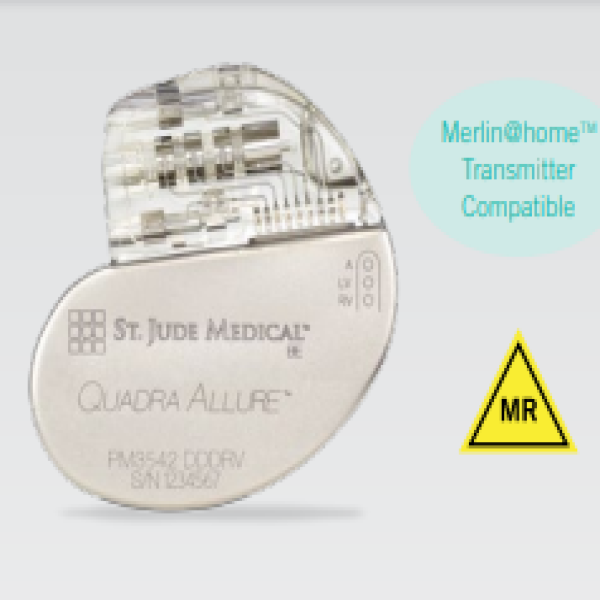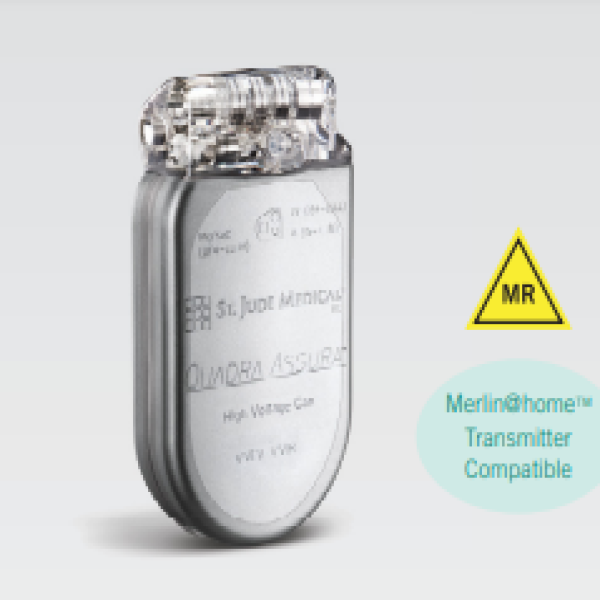


Quadra Assura MP™
- MRI Ready device has been tested for safe performance of an MRI scan using a 1,5 T (Tesla) field-strength MRI scanner when used in combination with MRI Conditional leads1,2
- MultiPoint™ pacing delivers multiple LV pacing pulses per cardiac cycle and is designed to improve haemodynamic and clinical response
- The Quadra Assura MP™ CRT-D and Quartet™ quadripolar LV pacing lead feature four pacing electrodes and 10 pacing vectors to provide more options and greater control to minimise implant complications such as diaphragmatic stimulation and high pacing thresholds
Call Us Now
- MRI Ready device has been tested for safe performance of an MRI scan using a 1,5 T (Tesla) field-strength MRI scanner when used in combination with MRI Conditional leads1,2
- MultiPoint™ pacing delivers multiple LV pacing pulses per cardiac cycle and is designed to improve haemodynamic and clinical response
- The Quadra Assura MP™ CRT-D and Quartet™ quadripolar LV pacing lead feature four pacing electrodes and 10 pacing vectors to provide more options and greater control to minimise implant complications such as diaphragmatic stimulation and high pacing thresholds
- Elevate Response Easily with Auto VectSelect Quartet™ Test offering an efficient workflow for complete results and programming at the touch of a button
- SyncAV™ CRT technology dynamically adjusts AV delays based on patient’s intrinsic conduction to encourage patient-tailored biventricular pacing
- Parylene coating for improved abrasion resistance
- DynamicTx™ Over-Current Detection Algorithm automatically changes shock configurations to ensure delivery of high voltage therapy when high current is detected
- Cold Can programmability provides an additional RV-SVC Shock Configuration to decouple the can from the shocking vector parameters in cases of lead problems
- ShockGuard™ technology with DecisionTx™ programming designed to reduce inappropriate therapy and minimise the need for programming adjustments at implant
- SecureSense™ RV lead noise discrimination detects sustained and short bursts of lead noise that would otherwise go unnoticed or potentially lead to one or more inappropriate shocks
- Far Field MD™ morphology discrimination and Chamber Onset discrimination improve SVT and VT discrimination for reduced inappropriate therapies
- Antitachycardia pacing (ATP) while charging and prior to charging in the VF zone further extends the programming options for terminating tachyarrhythmias without a highvoltage shock
- Low Frequency Attenuation filter is designed to enhance sensing performance and may reduce the possibility of oversensing T-waves
- SenseAbility™ feature provides flexibility to fine-tune programming around T-wave oversensing without decreasing sensitivity
- DF4 connector designed to streamline defibrillation connections into a single terminal pin and reduce the number of set screws
- Unique 40 J delivered energy safety shock option can provide a greater DFT safety margin
- DeFT Response™ technology offers the most noninvasive options for managing high DFTs
- QHR™† chemistry battery provides greater capacity for enhanced longevity and improved charge time performance compared to previous SVO batteries
- Vibratory patient notifier enables patients with hearing problems to be alerted to a low battery, lead-related complications and more
- CorVue™ congestion monitoring feature monitors the intrathoracic impedance in multiple vectors for improved accuracy, and it provides the option for both patient and physician alerts
- QuickOpt™ timing cycle optimisation provides quick and effective
optimisation at the push of a button
Indications: The devices are intended to provide ventricular antitachycardia pacing and ventricular
defibrillation for automated treatment of life-threatening ventricular arrhythmias. Cardiac Resynchronisation
Therapy Defibrillators (CRT-Ds) are also intended to resynchronise the right and left ventricles in patients with
congestive heart failure.
Contraindications: Contraindications for use of the pulse generator system include ventricular tachyarrhythmias
resulting from transient or correctable factors such as drug toxicity, electrolyte imbalance, or acute myocardial
infarction.
Adverse Events: Implantation of the pulse generator system, like that of any other device, involves risks, some
possibly life-threatening. These include but are not limited to the following: acute hemorrhage/bleeding, air
emboli, arrhythmia acceleration, cardiac or venous perforation, cardiogenic shock, cyst formation, erosion,
exacerbation of heart failure, extrusion, fibrotic tissue growth, fluid accumulation, hematoma formation,
histotoxic reactions, infection, keloid formation, myocardial irritability, nerve damage, pneumothorax,
thromboemboli, venous occlusion. Other possible adverse effects include mortality due to: component failure,
device-programmer communication failure, lead abrasion, lead dislodgment or poor lead placement, lead
fracture, inability to defibrillate, inhibited therapy for a ventricular tachycardia, interruption of function due to
electrical or magnetic interference, shunting of energy from defibrillation paddles, system failure due to ionising
radiation. Other possible adverse effects include mortality due to inappropriate delivery of therapy caused by:
multiple counting of cardiac events including T waves, P waves, or supplemental pacemaker stimuli. Among the
psychological effects of device implantation are imagined pulsing, dependency, fear of inappropriate pulsing,
and fear of losing pulse capability.
Refer to the User’s Manual for detailed indications, contraindications, warnings, precautions and potential adverse
events.
†QHR is a trademark of Greatbatch Medical